
3 Pin Plug vs CEE EV Chargers: Which Portable Charger Is Right for You?
Posted by Car Chargers on 17th Nov 2026
Are you confused about which EV charger type is right for your requirements? We’ll help you find the right EV charger for your car and specific requirements. When you’re planning to buy an electric vehicle but don’t have a home wallbox, a portable EV charger can be a convenient way to charge your EV at home, in a garage, at a workshop or while travelling. But before you choose an EV charger, there’s one important decision to make: 3 pin vs CEE plug EV charger.
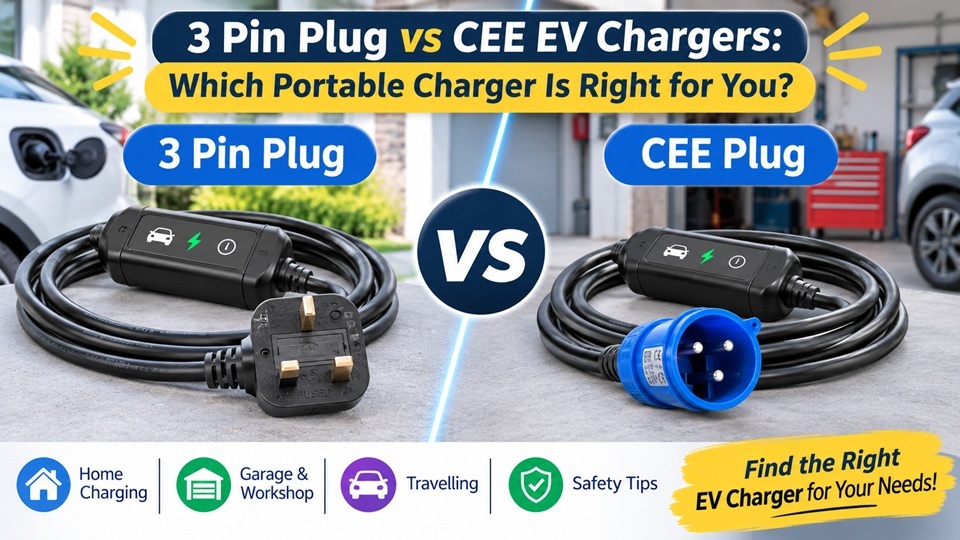
The plug type determines where you can use your charger, how much power it can typically deliver and what kind of electrical supply you need. In simple terms, a 3 pin EV charger plugs into a standard UK domestic socket, while a CEE charger connects to a dedicated industrial-style socket. Neither option is automatically right for everyone. Your best choice depends on whether you already have a CEE socket, how frequently you plan to charge and where you’ll be using the charger.
Let’s look at the differences so you can choose with confidence.
What Is a 3 Pin Plug EV Charger?
A 3 pin plug EV charger connects to the familiar UK domestic socket found in most homes. This makes it one of the most convenient portable EV charging options because you don’t necessarily need a dedicated charging socket installed to use it. A typical 3 pin portable EV charger operates at around 13A, with charging power generally up to approximately 2.3kW, depending on the charger and the electrical supply. The biggest advantage of 3 pin EV charger is flexibility. If you have a suitable domestic socket within reach of your vehicle, you can use your portable charger without needing a CEE outlet.
Advantages of a 3 pin EV charger
- Easy to use: Connects to a standard UK domestic socket.
- Portable: Useful as a backup charger or for travelling.
- Widely available: Standard sockets are much more common than CEE outlets.
- No CEE socket required: A practical option for occasional charging.
- Useful away from home: Convenient when visiting family or staying somewhere without a dedicated EV charging point.
What are the drawbacks of 3 pin EV charger?
The trade-off for convenience is 3 pin EV charging speed. A standard domestic socket provides considerably less power than many dedicated EV charging solutions, so adding a substantial amount of range can take many hours. There is also an important safety consideration. EV charging places a high electrical load on a socket for a prolonged period, which is different from briefly running a typical household appliance.
Considering the 3 pin EV charger safety, it is advised to avoid standard sockets for regular EV charging because the extended load can exceed what standard sockets and wiring are designed to handle. For this reason, your socket and electrical installation should be suitable for EV charging, and you should always follow the charger manufacturer's instructions. Avoid using unsuitable extension leads or overloaded sockets.
See our range of 3 pin plug EV chargers for more information.
What Is a CEE Plug EV Charger?
A CEE plug EV charger is a robust, industrial-style electrical connector with a round socket commonly found in places such as workshops, garages, caravan sites and other environments where higher-power electrical equipment is used. You may also hear CEE plugs referred to as Commando plugs or Commando sockets in the UK.
For portable CEE socket EV charging, two common versions are:
Blue CEE: Commonly 16A-32A, typically used for single-phase, providing around 3.68kW-7.36kW at 230V. This is the most preferred CEE EV charger for regular use.
Red CEE: Commonly associated with 32A and higher-power supplies. The exact electrical configuration and charging capability depend on the installation and charger. This typically uses a three-phase 400V application.
A CEE charger needs a matching CEE socket and it isn’t as universally convenient as a 3 pin charger. If an appropriate socket and circuit are already available, it can provide a more robust solution for regular portable charging.
Advantages of a CEE EV charger
- Higher charging power: A 16A CEE supply can typically provide around 3.7kW, while suitable 32A installations can provide substantially 7.4kW. This provides a faster EV charging setup with sustainable loads.
- Robust connection: CEE connectors are designed for demanding electrical environments.
- Ideal for dedicated circuits: Particularly suitable for garages, workshops and similar installations.
- Useful anytime: CEE sockets are commonly encountered at caravan and camping sites.
- Better suited to regular use: Where correctly installed, a dedicated CEE supply can be preferable to relying on a standard domestic socket for frequent charging.
What are the drawbacks of CEE EV charger?
The main limitation is actually simple, you need the right socket. If your home, garage or regular destination doesn’t already have a suitable CEE outlet, you’ll need to have one installed by a suitably qualified electrician. The socket, circuit and protective devices must all be appropriate for the intended charging load. A CEE charger therefore makes most sense if you already have access to a suitable CEE supply or specifically want a dedicated portable charging setup.
3 Pin vs CEE Plug EV Charger: Charging Speed Compared
EV charging speed depends on several factors, including the charger, available electrical supply, your EV's onboard charger and the vehicle's battery.
Please note: The figures below are for illustrative purposes and figures may vary.
As a rough example, assuming an EV uses around 3 miles of range per kWh:
| Plug type | Typical power | Approx. range added per hour* | Approx. time to add 50 miles* |
| 3 pin plug | ~2.3kW | ~9 miles | ~5–6 hours |
| Blue CEE 16A | ~3.7kW | ~11 miles | ~4–5 hours |
| Blue CEE 32A Single Phase/ higher-power supply | ~7.4kW | ~22 miles | ~4–5 hours |
*Approximate figures only. Actual charging times vary according to the vehicle, battery state, charging losses, charger settings and electrical supply.
For a more detailed explanation of the factors that affect EV charging times, see our guide to EV charging speed and what affects charging time.
The key takeaway is that 3 pin charging prioritises accessibility, while CEE charging can offer more power where a suitable dedicated supply is available.
3 Pin EV Charger Safety: What You Need to Know
Using a portable EV charger doesn't have to be complicated, but safety should always come first. A standard domestic socket for 3 pin EV charger may be rated for 13A, but EV charging is a continuous load that can run for several hours. A socket that works perfectly well for a kettle or vacuum cleaner is not necessarily ideal for regular, prolonged EV charging. Dedicated circuits for EV charging reduce the risk that extended EV charging loads can place on standard sockets and wiring.
Before using a 3 pin portable EV charger:
- Make sure the socket and electrical installation are suitable for EV charging.
- Follow the charger's instructions regarding current settings and installation.
- Don't overload the socket with other appliances.
- Avoid unsuitable extension leads, and never daisy-chain them.
- Check plugs and sockets for signs of damage, overheating or burning.
- Ensure appropriate RCD protection is provided as required by the installation and charger.
- If you're unsure whether your electrical installation is suitable, speak to a qualified electrician.
- Follow government approved standard EV charger guidelines for safety.
An RCD, or residual current device, is designed to help protect against electric shock if an electrical fault occurs.
CEE charging can be a good choice for frequent portable charging because a properly installed CEE socket is designed for higher-demand electrical equipment. However, the fact that a socket is a CEE socket does not automatically make every installation suitable for EV charging. The circuit, protection, socket rating and charger must all be appropriate.
Which Portable EV Charger Should You Choose?
Still deciding between a portable EV charger UK plug and CEE connection? Use this quick guide.
Choose a 3 pin EV charger if:
You don't have a CEE socket - If you're looking for a portable option that works with a suitable standard UK socket, a 3 pin charger is the straightforward choice.
You only need occasional charging - A 3 pin charger can be particularly useful as a backup or when travelling, especially if charging speed isn't your main priority.
You want maximum flexibility - Standard sockets are much easier to find than CEE outlets, making a 3 pin charger useful for visiting friends, family or accommodation where dedicated EV charging isn't available.
Explore our range of 3 pin plug EV chargers.
Choose a CEE EV charger if:
You already have a suitable CEE socket - If your garage, workshop, caravan site or other regular charging location already has the right CEE outlet, a CEE portable charger could be the better match.
You charge regularly - If portable charging is going to be part of your normal routine rather than an occasional backup, the additional power and robust connection of a suitable CEE setup can make more sense.
You need a solution for leisure or workshop use - CEE sockets are commonly used in environments such as workshops, garages and caravan facilities, making CEE charging particularly useful for EV owners who spend time in these locations.
Explore our range of CEE EV chargers.
What About Home EV Charging Without a Wallbox?
A portable charger can provide a practical alternative when you don't have a wallbox, but it's important to understand the difference between portable charging and a permanently installed home charge point.
A 3 pin charger offers convenience and portability, but it is generally the slower option and isn't the preferred choice for regular domestic EV charging.
A CEE setup can provide a more robust portable solution where a suitable dedicated circuit and socket are installed. However, if you charge your EV every day at home, it may be worth considering a dedicated wallbox for greater convenience and faster charging.
Ultimately, the right choice comes down to how you use your vehicle and what electrical infrastructure you have available.
3 Pin vs CEE: The Simple Answer
If you need maximum portability and access to ordinary UK sockets, a 3 pin EV charger is likely to be the most convenient option.
If you have a suitable CEE socket and want faster, more robust portable charging, a CEE EV charger may be the better choice.
Neither plug type is universally better. The best portable EV charger is the one that matches your electrical supply, charging habits and intended use.
Find the Right Portable EV Charger
Not sure which connection is right for your EV? Browse our range of 3 pin and CEE portable EV chargers and choose the option that fits your setup.
For standard domestic socket charging, explore our 3 Pin Plug EV Chargers.
For higher-power CEE socket charging, explore our CEE EV Chargers.
Still unsure? Call our experts on 01865 686 469 for help choosing the right portable charger for your vehicle and electrical setup or email us at sales@car-chargers.com.